Talk & Connect: Daily Prompts for Parent-Child Bonds

Talk & Connect: A Parent-Child Communication Workbook for Stronger Bonds
Meaningful family conversations don’t happen by accident—especially with busy schedules, big feelings, and growing independence. A structured workbook can make it easier to listen well, respond calmly, and build emotional closeness through simple prompts and repeatable routines that fit real life.
Why communication gets harder as kids grow
As children move from early childhood into the school years and beyond, everyday life adds friction in places that used to feel simple. Rushed transitions (wake-up, drop-off, pickup), competing priorities (homework, activities), screens, sibling dynamics, and power struggles can turn a normal check-in into a shutdown—or a blowup.
Stress also changes the tone of conversations. Adults tend to go “task-first,” which can sound like rapid-fire questions or corrections. Kids often respond with short answers, defensiveness, or going quiet. When either side feels misunderstood, the gap widens fast.
What kids often need most is surprisingly basic: predictable attention, emotional safety, and a chance to be understood before being corrected. When a child feels heard, they’re more likely to accept coaching, boundaries, and problem-solving.
And when conflict does happen (because it will), small repair moments matter. A quick reconnection—an apology for a harsh tone, a reset, a brief hug—can keep distance from becoming the norm and remind everyone that the relationship is bigger than the moment.
What “Talk & Connect” is designed to do
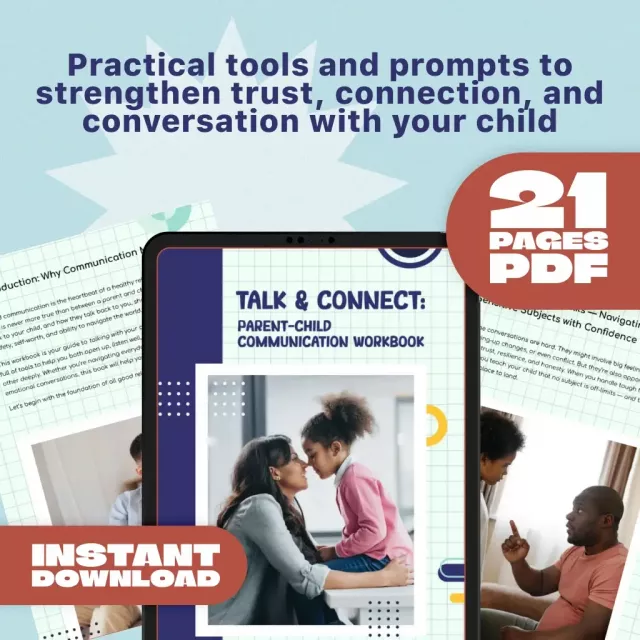
Talk & Connect: Parent-Child Communication Workbook is built for families who want more than “say this line” advice. It uses guided exercises and conversation starters to turn awkward silence into doable prompts—especially helpful when kids default to “fine,” “nothing,” or “leave me alone.”
One of its most practical benefits is emotional vocabulary. Kids learn to name feelings with more precision than “mad” or “sad,” and parents practice reflecting feelings without escalating. That reflection step can be the difference between a child feeling judged and a child feeling safe enough to keep talking.
The workbook also supports positive parenting routines: connection first, then coaching and boundaries. Instead of leading with consequences, it encourages a calmer sequence—listen, validate, and then move into solutions or limits.
Finally, it emphasizes consistent micro-habits. A five-minute check-in done most days does more for trust than an occasional “big talk” that happens only after problems explode.
A simple daily rhythm: connect, reflect, problem-solve
A repeatable rhythm helps kids know what to expect and helps parents avoid accidentally sliding into lectures. The goal isn’t perfect communication—it’s a dependable path back to connection.
Connect
Start with a low-stakes opener: “best part/worst part,” “tell me more,” or a shared memory that invites a story. When the opener feels safe, kids are more likely to move from facts (“we had math”) to meaning (“I felt dumb when I got stuck”).
Reflect
Mirror back what you heard before giving advice. Try “emotion + meaning”: “That sounds disappointing—you really wanted it to feel fair.” Reflection is not agreement; it’s proof you’re listening.
Problem-solve
Collaborate on one next step that’s clear, small, and time-bound. “Tomorrow, do you want to text me ‘need a reset’ after school, or should we do a five-minute quiet break first?” Small steps are easier to repeat—repetition is what creates change.
Close
End with reassurance and a positive cue—appreciation, a hug/high-five, or a short shared activity. Many families pair check-ins with a predictable “connection cue,” like a short walk or a bedtime routine. If bedtime is a common window for conversations, a calm, cozy setup can help; a kid-friendly room upgrade like the Twin Size Upholstered Bed with LED Lights and Crown Headboard can make the wind-down period feel more inviting and consistent.
Conversation starters by situation
| Moment | Starter | What it helps with |
|---|---|---|
| After school | “What’s something that felt easy today—and something that felt hard?” | Moves beyond “fine” and invites details |
| Before bed | “If your day had a headline, what would it be?” | Encourages storytelling and emotional processing |
| During conflict | “What do you need right now: space, help, or a hug?” | De-escalation and needs awareness |
| When a child shuts down | “Want to talk now, or should we set a 10-minute time to try again?” | Respects autonomy while keeping connection |
| Building confidence | “What’s something you’re proud of that nobody noticed?” | Reinforces internal motivation and self-worth |
| Family teamwork | “What would make mornings 10% easier for you?” | Invites practical collaboration instead of blame |
How to use a communication workbook without making it feel like homework
Parent language that builds emotional safety
For more guidance on supportive connection and parenting approaches, reputable starting points include the American Academy of Pediatrics (HealthyChildren.org), the CDC Essentials for Parenting, and the American Psychological Association’s parenting resources.
Who this workbook can help most
Product snapshot: Talk & Connect workbook
If you’d like a structured set of prompts you can reuse, find it here: Talk & Connect: Parent-Child Communication Workbook.
FAQ
What if my child refuses to talk or says “nothing” to every question?
Lower the stakes and offer choices: “Want a yes/no question or an open one?” Indirect moments (car rides, cooking together) can feel safer than face-to-face talks, and consistency matters more than immediate disclosure.
How long should a connection check-in last to be effective?
Most days, 5–15 minutes is plenty when it’s predictable and warm. Save longer conversations for calm times, and prioritize ending with reassurance rather than pushing for a full resolution.
Can these prompts work for teens without feeling childish?
Yes—use autonomy-respecting wording, let the teen choose prompts, and collaborate on next steps. Teen-friendly angles like stress, friendships, values, and goals tend to land better than overly cute or scripted language.















Leave a comment